" alt="" >
Gambling licences 2024
Do you want to participate in a lottery, gamble in a casino, online or on a slot machine? Gambling companies in the Netherlands have to comply with regulations and therefore have a licence to offer online games of chance. At this time 27 companies have a official license and 22 websites are now active.
The Dutch government has given the first licences to online casinos from 1 October 2021. From 1 October 2021, it is therefore possible to gamble legally online from the Netherlands.
The Kansspelautoriteit (the Dutch gambling authority) announced today to 10 companies that they will receive a licence with which they can offer gambling via the internet as of 1 October 2021. Afterwards, new casinos are admitted to the Dutch market. It is expected that there will be up to 50 licensed gambling shops in Holland.
The 10 licenses online gambling for 1-10-2021
- TOTO Online B.V.
- FPO Nederland B.V.
- Holland Casino N.V.
- NSUS Malta Limited
- Play North Limited
- Tombola International Malta Plc
- Hillside (New Media Malta) Plc
- Bingoal Nederland B.V.
- Betent B.V.
- LiveScore Malta Limited
Second roud license
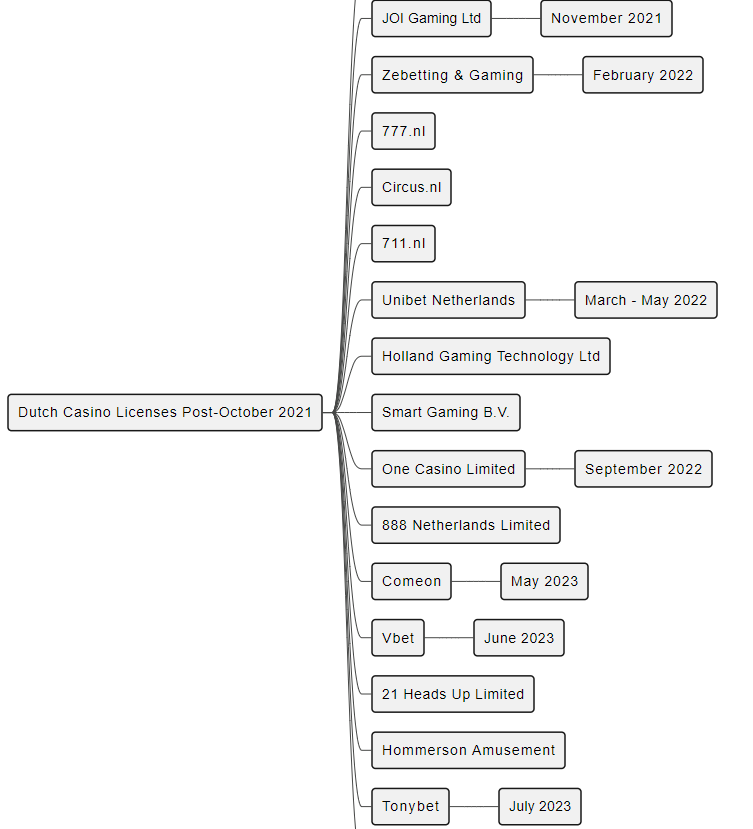
Gambling license after 23 october 2021
November 2021
The licence is due to take effect on 20 November 2021. The Dutch Gambling Authority has granted a licence to JOI Gaming Limited to offer games of chance via the Internet.
Horse betting license
In February 2022, ZEbetting & Gaming Netherlands BV ( ZEbetting) is the only organisation in the Netherlands licence for the organisation of (physical) bets on the trotting and racing.
March - May 2022
New licenses for online casino:
September 2022
May 2023
June 2023
- Vbet is a well-known name in the international online gaming industry. The online casino also holds licences from the Gambling Commission in the UK and the Malta Gaming Authority. VBET NL only offers sports betting on live broadcasts and sporting events.
July 2023
- 21 heads up limited
- Hommerson amusement
- Tonybet
October 2023
Online casino in the Netherlands could intervene faster and better in case of immoderate play or possible gambling addiction
Licensees of online gambling could intervene faster and better in case of immoderate play or possible gambling addiction. This does not happen enough at the moment with too many providers. This is the conclusion of the Kansspelautoriteit (Ksa) after an extensive investigation into the fulfillment of the duty of care at 10 providers of online gambling on the Dutch market. Based on the results, the Ksa will work on tightening its own policy and recommendations for adaptation of laws and regulations by the Ministry of Justice & Security.
Lottery gambling license
For the organisation of the games of chance of the Dutch Lottery, licences have been granted by the Kansspelautoriteit to Staatsloterij B.V., Lotto B.V. and TOTO Online B.V.
What fines have Dutch casino licence holders received?
Dutch licence holders must also strictly adhere to the rules. Having a gambling licence does not mean you can sit back and not be checked. Nothing could be further from the truth. These parties are also monitored, and just as well. They also regularly break gambling laws. The fines below were handed out recently for various reasons.
Bingoal Netherlands B.V. on February 8, 2023
Bingoal enabled participation in online gambling without checking players for registration in Cruks. The Gaming Authority imposes a fine of €350,000.
JOI Gaming Ltd on 25 January 2023
JOI Gaming Limited has advertising aimed at young adults. This contravenes the Decree on the recruitment, advertising and addiction prevention of gambling, the Games of Chance Authority imposes a fine of €400,000.
Is online gambling legal in the Netherlands?
If a gambling site has a Dutch licence, it is legal to gamble there online. It is expected that the number of companies where this is possible will rise to 40 to 45 in the course of 2022. The logical consequence is that players are not allowed to gamble legally at gambling companies without a Dutch licence. There are a lot of them, because that applies to all foreign gambling companies. They are obliged to take measures to block visitors from the Netherlands. The Dutch Gambling Authority checks this, but it is not easy. After all, the number of foreign gambling sites is so large that not every offender is discovered. You can therefore say that illegal gambling at a foreign site is tolerated in practice.
Visitors of an online casino who also sometimes play in a gaming hall will experience that in an online casino more money can be lost per hour. In a slot machine hall, the maximum average loss per hour is determined by law. This is calculated back to an hourly loss. By calculating the hourly loss in this way, higher and lower hourly losses are eliminated. The maximum hourly loss for slot machines and slot machines in an amusement arcade is set at € 40. Keep in mind that in an online casino this can be much higher.
What are the KSA's sanction decisions and fines in 2023?
Probe Investments Limited
3 March 2023- Probe offered online gaming without a licence. The Kansspelautoriteit imposes a fine of €1,128,000.
Betpoint Group Limited
3 March 2023- Betpoint offered online gaming without a licence. The Games of Chance Authority imposes a fine of €1,787,000.
N1 Interactive Limited
3 March 2023- N1 offered online gaming without a licence. The Games of Chance Authority imposes a fine of €12,640,000.
Videoslots Limited
3 March 2023- Videoslots Limited offered online gaming without a licence. The Games of Chance Authority imposes a fine of €9,874,000.
Which gambling sites are illegal now in the Netherlands?
Fo example a few brand who have no license:
- 888
- Oranje Casino
- Kroon Casino
- Mr Green
- Thelotter
- Betsson
- Bob Casino
- Cashiopeia Casino
- Avalon78
- Betamo
- Slotty Vegas
- WHamoo
- Wild Casino
- Playfrank
- PaddyPower
- AmokCasino
- Sugar Casino
- Scatters Casino
- Evospin
- Dux
Check here more about illegal gambling.
Future legal online gambling providers
After the first ten providers were licensed in October 2021, another five companies were licensed in February 2022. In the course of 2022, several more will be added. Companies whose applications are pending are Bwin, Unibet, Polder Casino and Pokerstars. There may be a few more applications in addition.
In order to get a license, the companies have to provide a lot of documentation. Such as:
- Policies and a practical implementation when dealing with visitors with a gambling addiction;
- Proof that player's funds are handled responsibly;
- Guarantees that the integrity is and remains in order;
- A link realised with CRUKS;
- Storing near real-time data on the progress of the game in a control database.
Measures to prevent gambling addiction
Politicians in the Netherlands have long struggled with legislation to open up the online gambling market because of the fear of creating gambling addictions. For this reason, strict requirements are imposed on the providers of these websites. Among other things, they must:
- Identify visitors and check that they are 18 years of age or older;
- Provide staff with demonstrable knowledge of how to prevent a gambling addiction;
- Have an action plan if a gambling addiction is detected;
- Provide information to players about the game they are playing;
- carrying out risk analyses for each category of game;
- monitor players' behaviour in real time and take action if necessary;
- have a link with CRUKS.
Advertising rules Holland
Online casinos are allowed to advertise, but this must meet strict conditions. The advertisements must not have an aggressive recruiting character. This means that high welcome bonuses may not be used to incite people to play at a casino. It is also not allowed to create the impression that a visit to an online casino always leads to high profits. For more information on what is and what is not allowed regarding advertising online gambling, please visit the website of the KSA, the Dutch Gaming Authority.